If you spend enough time researching how to start an online business, you’ll notice something strange. Some articles claim you can launch a store for almost nothing, while others suggest you need a serious investment before selling your first product. Neither view is completely wrong, but neither tells the full story either. The real cost of starting an online business in 2026 depends less on technology and more on how prepared you are for what happens after launch.
A decade ago, simply having an e-commerce website gave businesses an advantage. Today, customers move between dozens of stores every week, often without realizing it. They compare speed, trust, delivery expectations, and overall experience almost instantly. Because of that, starting online is still accessible, but competing online requires more thoughtful planning than many first-time founders expect.
Businesses that work with e-commerce development partners such as Proactivo Commerce often discover that success is rarely about spending aggressively. It usually comes down to understanding where investment actually makes a difference early on. You can explore how the e-commerce strategy and development support work here
Most unexpected costs appear not at launch, but a few months afterward, when growth begins to expose weak foundations.
Website Development and Platform Costs
The website is usually the first thing people budget for, and understandably so. Platforms like Shopify have made it possible to build a functioning store without deep technical knowledge. That accessibility sometimes creates the impression that development costs are minimal, but the reality tends to unfold differently once real customers arrive.
A template might be enough to start testing an idea, yet growing businesses quickly notice limitations. Pages load slightly slower than expected, navigation feels crowded on mobile devices, or checkout steps create hesitation. None of these problems seems dramatic on their own, but together they quietly affect conversions.
Many founders try to solve these issues gradually, adjusting settings or installing additional apps along the way. Over time, that patchwork approach often becomes more expensive than investing in structured development from the beginning. Agencies such as Proactivo Commerce typically focus on building stores that can evolve without constant redesign, which becomes valuable once traffic starts increasing.
Branding Is Rarely a Small Expense
Branding tends to be underestimated because it feels intangible at first. A logo can be created quickly, and colors can be chosen in an afternoon. What takes longer is building something that feels trustworthy to someone seeing your business for the first time.
In 2026, shoppers are highly sensitive to presentation. Product photography, tone of voice, layout consistency, and even spacing on a website influence whether visitors stay or leave. Many online businesses struggle early not because their products are weak, but because the brand feels unfinished.
Investing in branding often reduces friction later. Customers hesitate less, advertising performs better, and repeat purchases become more likely. It’s one of those costs that rarely produces instant results but compounds quietly over time.
Product Sourcing and Inventory Choices
Product investment varies widely depending on how a business operates. Some founders prefer dropshipping because it reduces upfront risk, while others choose to manage inventory directly for better control over quality and fulfillment.
Both approaches come with trade-offs. Dropshipping allows experimentation without large commitments, though margins and shipping timelines can be harder to manage. Inventory requires more capital upfront but often improves customer experience.
Many successful stores start cautiously, testing demand before expanding operations. The important part is recognizing that product cost extends beyond the item itself. Packaging, storage, shipping adjustments, and returns gradually become part of the financial picture.
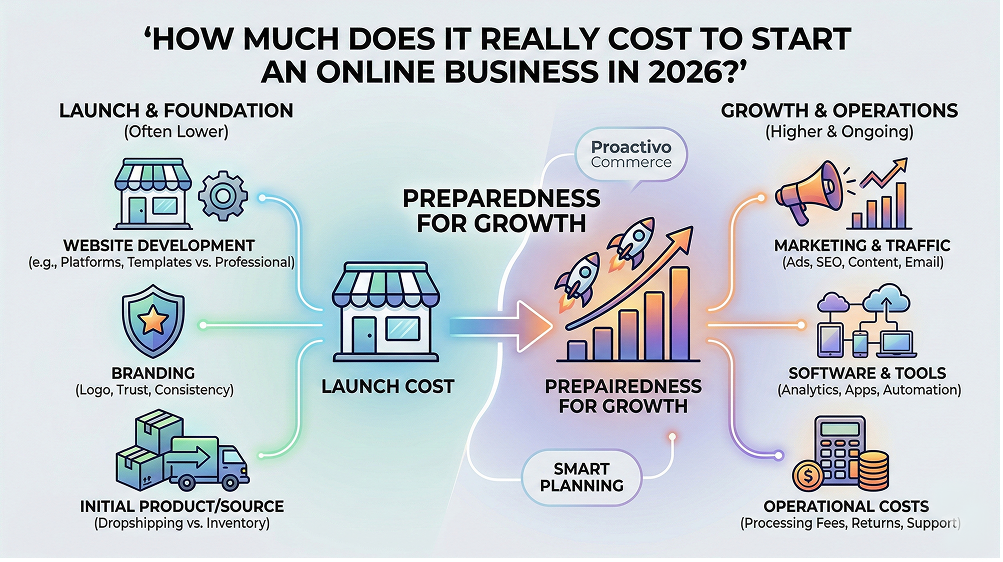
Marketing Often Becomes the Largest Expense
One of the most common surprises for new entrepreneurs is how difficult visibility can be. Launching a website does not automatically bring visitors, even when products are strong. Marketing becomes an ongoing effort rather than a one-time investment.
Paid advertising can generate early traffic, but relying on ads alone often becomes expensive as competition increases. Businesses that combine advertising with long-term strategies such as SEO, content creation, and email marketing usually build more stable growth.
This is where development and marketing begin to overlap. Stores designed with search performance and conversion behavior in mind tend to extract more value from every visitor. Many brands work with ecommerce agencies like Proactivo Commerce to align these areas instead of treating them separately.
Software, Tools, and Automation Add Up Quietly
Modern ecommerce runs on a collection of tools working behind the scenes. Email platforms, analytics dashboards, inventory systems, customer support tools, and automation apps all contribute to daily operations.
Individually, these subscriptions seem manageable. Together, they form a steady monthly expense that grows alongside the business. Founders often install more tools than necessary in the early stages, only realizing later that simplicity often performs better.
Automation has become especially important by 2026. Small teams now rely on automated workflows to manage communication and customer journeys efficiently without expanding staffing costs too quickly.
Operational Costs That Appear Later
Some expenses only become visible once orders begin arriving consistently. Payment processing fees, delivery complications, customer service time, and product returns gradually influence profitability.
These operational realities rarely appear in startup checklists, yet they shape long-term sustainability more than launch costs themselves. Businesses that plan operational systems early usually experience smoother scaling when demand increases.
The Hidden Cost of Starting Too Cheaply
Interestingly, one of the most expensive approaches is trying to minimize every upfront cost. Stores launched without optimization often struggle with conversion issues, leading founders to spend more on advertising just to maintain sales.
Slow loading pages or confusing checkout experiences quietly reduce performance. Instead of fixing the root issue, businesses sometimes increase marketing budgets, which only masks the problem temporarily.
Improving performance early tends to produce stronger results than chasing traffic alone.
So What Does It Really Cost
There isn’t a single number that defines startup cost anymore. Some businesses begin lean and grow gradually, while others invest more upfront to accelerate momentum. Both paths can work when decisions are intentional.
What matters most is understanding that ecommerce success rarely comes from launching quickly and hoping for traction. It comes from building systems that support growth once customers arrive.
Final Thoughts
Starting an online business in 2026 remains one of the most realistic ways to build something independently, but expectations have changed. Customers notice details quickly, and those details often determine whether a brand earns trust.
Rather than focusing only on how little it costs to start, many successful founders now think about how well their investment prepares them for growth. If you are planning to launch or scale an ecommerce business, exploring structured guidance can help clarify priorities early. You can learn more about ecommerce development and growth
Understanding the real cost doesn’t make entrepreneurship harder. It simply replaces assumptions with clearer decisions.